

Special Guest Feature: Kate Wade | Purpose Fueled Plymouth
Kate Wade spent years watching who got promoted inside a Fortune 200 company, and it taught her something most career advice gets wrong.
She’s CEO of Get Her Hired, and she believes the gap between doing great work and getting credit for it isn’t confidence. It’s positioning.
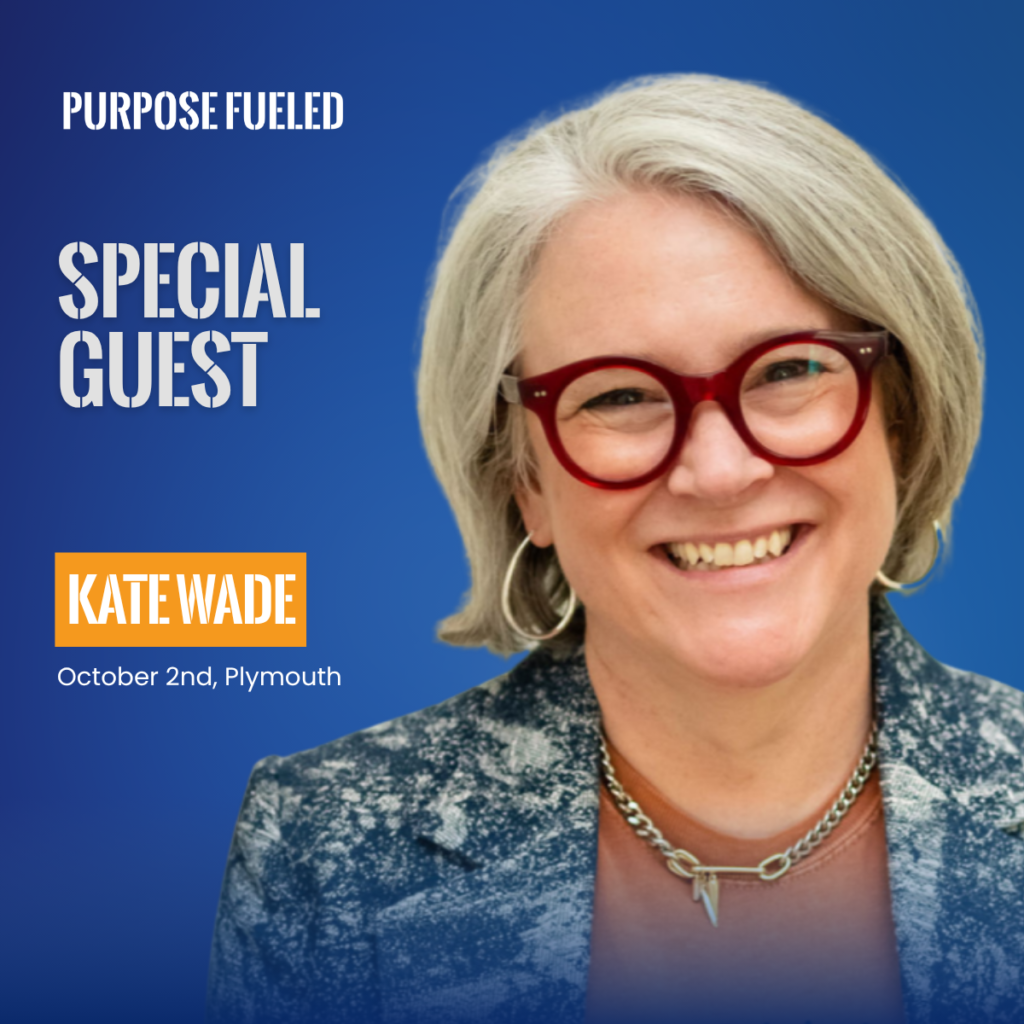
Kate is our Special Guest at Purpose Fueled | Plymouth, hosted by Molly Monahan, CCMP.
Here is more about her, in her own words.
What do you actually do (in plain language), the way you’d explain it to a friend over coffee?
We help people put a market value on the hard-won career expertise they’ve normalized.
What’s the moment or decision that changed the direction of your life or career?
Getting sober. I’d just been promoted, and I understood the gift and opportunity I was being given. I also understood that I was living two lives, and that the “secret” one was winning more often than not. I was scared; I thought sobriety would be about removing something, losing part of me. Instead, it gave me unlimited gratitude and potential. I had no idea how much capacity I had for growth, joy, and peace until I stopped drinking. To be clear, I had never lacked confidence. I had enormous confidence, but it was built on flimsy reeds rather than solid bricks. My drunk ego wasn’t quiet. It was loud, and it was sitting in the exact spot where my real potential was. People had long seen something in me that I couldn’t see. Ten years sober, I can.
What do you believe about people that most others in your field don’t?
In my world, when a talented executive isn’t getting promoted, the standard answer is confidence. They need to advocate more, own their wins, believe in themselves.
I disagree. Seven years of my own data says it’s positioning. Facts, not emotions. Positioning means simply how a leader’s work is described when they aren’t there to explain it. The résumé, the review, the promotion deck. I spent my corporate career in strategy at a Fortune 200 watching those rooms, and the people who moved up were rarely the ones doing the most. They were the ones positioned the best.
The difference matters more than it sounds. If you believe it’s confidence, you send someone off to work on themselves. They read the book, do the therapy, practice the power pose, and the promotion deck still says “supported the initiative.” If you believe it’s positioning, you give them a writer. The first diagnosis costs them years. The second costs them an afternoon. And that bill lands on women far more often, which is why I stopped being polite about it. We market to women. We work with everyone.
What are you most proud of, in life, not just in work?
Building something that holds other people up.
Get Her Hired didn’t start as a business idea. People kept asking me for help, and they kept asking because of how I’d been operating my whole life: six things I’d never been willing to negotiate on, about dignity, inclusion, and refusing to let anyone’s limits become somebody’s ceiling. I hadn’t written any of it down. It was just how I worked. The business showed up because enough people wanted that.
I built it from there without outside money, one client at a time. But the business isn’t the thing I’m proud of. What it made possible is. There’s a team now, people doing meaningful work and getting paid for it. There are organizations I believe in that I can actually write a check to. There are people who needed a second chance and got one here. I spent a long time being the person who needed the support. Being on the other side of that is the part I’d put above anything else in my life.
What did you want to be when you grew up?
I had a clear desire at 14 to be a diplomat. I went to public school in Chicago, and there were so many languages and cultures and foods around me all the time. I pictured the UN, the German Bundestag, or Europe before there was an EU. I trained in literature, a master’s in German and a PhD I started, and I happened to be able to translate. My fascination was never the words. It’s everything a culture assumes and never says out loud.
Corporate America is a culture. It has its own idiom, its own tells, its own things everyone knows and nobody writes down. And it’s opaque, unfairly so, in a way that consistently favors the people who arrived already knowing the code. My clients are fluent in the work and reading a market that won’t say the rules out loud. I’m doing the same job I trained for. The difference is that this time the opacity isn’t an accident of distance between two languages. It’s a structure, and somebody benefits from it.
How do your closest friends or family describe you? Who do they say you are?
Caring, selfless, creative, curious.
What don’t people know about you that they should?
I play and teach Irish traditional music. It’s an oral tradition, learned by ear, passed person to person, almost none of it written down. Which is either a strange hobby for a woman who makes her living writing things down, or the least strange hobby possible.
What does “purpose” mean to you personally?
Purpose is what I use when things fall apart, and I mean that structurally rather than emotionally.
Here’s an example. This past winter, when ICE was taking people, I hit a wall. I could not make the math work on why I should be posting and writing and talking to people about jobs while people were being disappeared. Why does any of this matter. I genuinely don’t know what I might have done without something fixed underneath me.
What held was having a mission that was written down and specific: to help 10,000 women, thems, and cool men land their next boss roles. That isn’t a feeling, it’s a number and a direction, which means it still works on a day when nothing feels like it works. I could look at it and know that the thing in front of me was still useful, and I could keep going, and I could keep the team going, which in a hopeless stretch mattered more to me than whether I personally felt inspired.
That’s what purpose is for, as far as I’m concerned. Not the good days. It’s for the days I would otherwise have stopped.
What’s the title of your next chapter, in life or in business?
“Nine to Five, But We’re Keeping the Company.”
If you haven’t seen it, three women in an office get fed up with a boss who takes credit for their work and underestimates every one of them. Through a series of events I won’t get into, they end up running the place. And here’s the part everyone forgets: they’re extraordinary at it. Flexible hours, job sharing, on-site daycare, equal pay. Productivity goes up. The company gets measurably better, because the people who actually understood how the work got done were finally the ones designing it. In the movie they eventually hand it back. That’s the part I’d change.
My target is outplacement. When a company lays people off, it typically buys them something called outplacement services, and most of what gets bought isn’t much. A login to a portal, a template library, a few sessions with someone working from a script. The company checks a box in good faith, the person gets a generic product at one of the harder moments of their professional life, and the whole category survives on the fact that the buyer and the user are two different people. Nobody set out to build it that way. It just never got fixed. We’re going to fix it, which means taking what we’ve been doing one person at a time and bringing it to the companies doing the laying off, and building the platform to deliver it at scale.
But the part I actually want is the team. I want a business where the people building it are doing what they’re good at and what they love, getting paid well for it, and not burning themselves down to do it. I’ve had the other kind of job. If I’m going to build something, the inside will be as good as what we’re selling on the outside.
What’s one thing you’re hoping people leave your conversation thinking about?
That unnamed work is deniable work, and deniable work gets denied. Every system that decides a career runs on named work. The résumé, the performance review, the promotion deck, the layoff list, the screener reading your file before a human ever does. And most of us don’t name our work.
So here’s the question I’d want someone to sit with. You win the lottery on Friday, and you have two weeks to hand your job to whoever replaces you. What would you have to teach them that isn’t in your job description, isn’t in any document, and lives entirely in your head? That’s your actual job. Now ask whether a single word of it exists anywhere a stranger could find it. For most senior people the honest answer is no, and that gap is the whole reason my company exists.
What’s a question you wish more people would ask you?
“Who’s hard to help?”
Everyone asks about the wins. Nobody asks about the people I couldn’t get there, and there have been some. It’s almost always the person who already knows everything. She comes in with the résumé she’s used for fifteen years, and she’s here for a polish, not a rethink. Every suggestion gets met with why that won’t work in her industry. And I understand the instinct completely, because knowing how things work is exactly what got her this far.
But the thing that made her successful inside a company is the thing making her invisible outside of it. The rules changed and nobody sent a memo. If she can’t entertain the possibility that she’s playing by a version of the rules that expired, there’s nothing I can write that will help. I can fix a sentence. I can’t fix certainty.
Come meet Kate
Kate Wade is our Special Guest at Purpose Fueled | Plymouth on Friday, October 2nd, hosted by Molly Monahan, CCMP.
PickleX, 3955 Annapolis Lane, Plymouth. Doors open at 7:00 AM and the event begins at 7:30 AM.
Come hear her story and bring your answer to her question. Register here.